Crawlspace Encapsulation in Kentucky: How to Control Moisture, Mold and Humidity Under Your Home
Your crawlspace may be out of sight, but it should never be out of mind.
Excess moisture underneath a home can contribute to mold growth, wood deterioration, musty odors, high humidity, condensation and poor conditions throughout the structure.
At Phoenix Remediation & Restoration, we approach crawlspace encapsulation as a moisture-control system, not simply a piece of plastic laid across the ground.
A properly designed crawlspace system should address where moisture is coming from, how water is moving around the foundation and what is needed to control the environment beneath the home.
If you are dealing with a wet, humid or mold-affected crawlspace in Central or Eastern Kentucky, you can also schedule a crawlspace inspection online.
What Is Crawlspace Encapsulation?
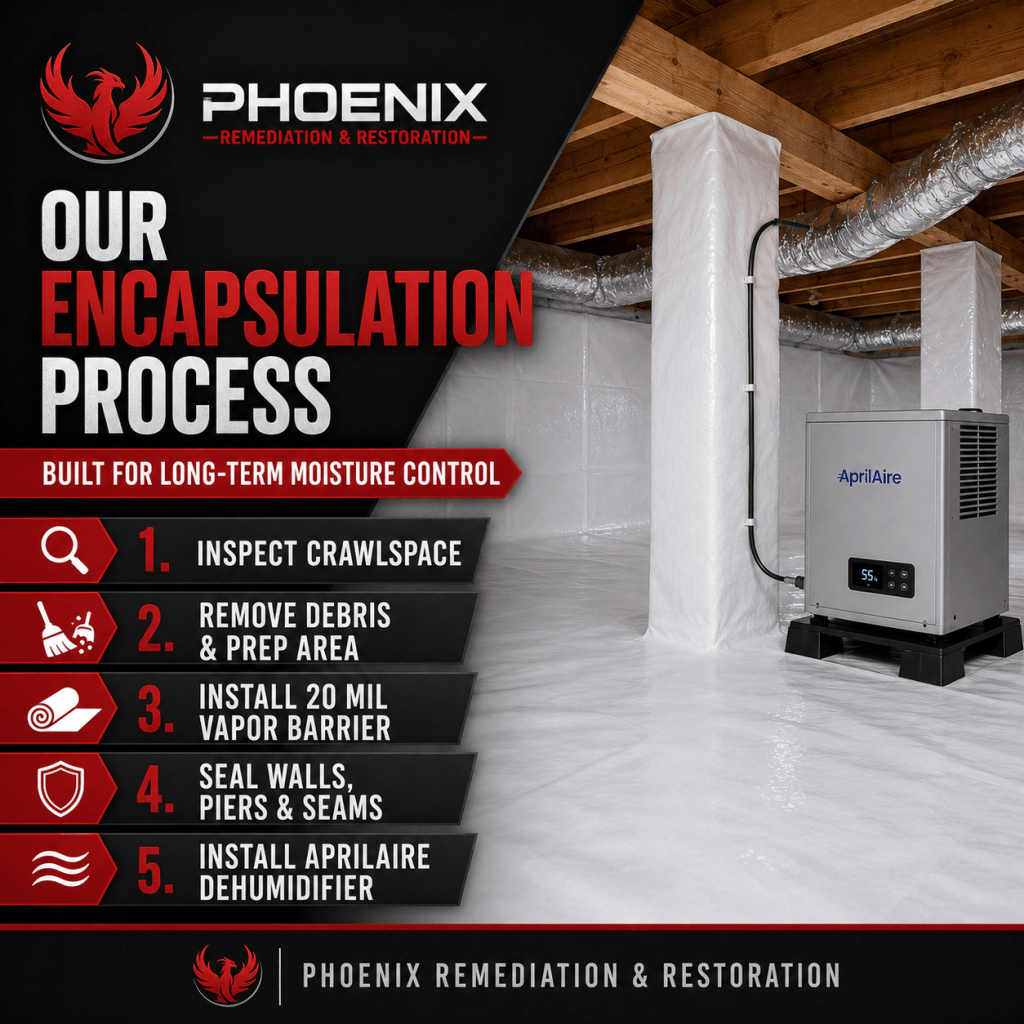
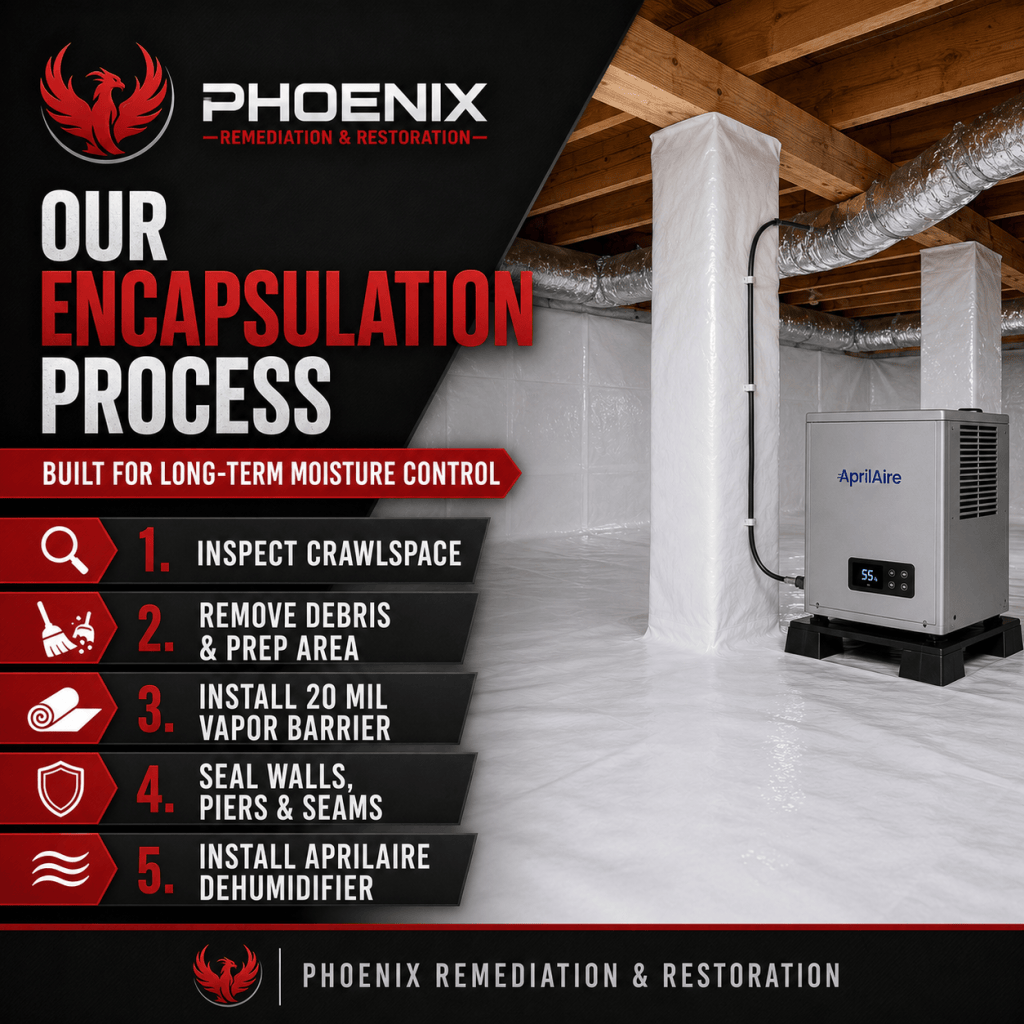
Crawlspace encapsulation is the process of creating a controlled moisture barrier between the crawlspace and the surrounding ground and outside environment.
A comprehensive encapsulation system may include:
- Heavy-duty crawlspace liner
- Ground vapor barrier
- Sealed foundation walls
- Sealed support columns or piers
- Sealed seams and penetrations
- Crawlspace vent sealing
- Drainage improvements
- Sump pump systems
- Crawlspace dehumidification
- Moisture monitoring
- Mold remediation when needed before encapsulation
The goal is to reduce the amount of ground moisture, outside humidity and water intrusion affecting the crawlspace.
You can learn more about Phoenix and the restoration services we provide through our Google Business Profile.
Why Are Crawlspaces So Prone to Moisture?
Many crawlspaces contain exposed soil.
Although the ground may look dry, moisture can continuously evaporate from the soil into the crawlspace air.
Without an effective vapor barrier, that moisture can increase relative humidity underneath the home.
Additional moisture may enter through:
- Foundation vents
- Poor exterior grading
- Groundwater
- Plumbing leaks
- Condensation
- Improper downspout discharge
- Standing water
- Foundation seepage
- Drainage failures
- HVAC condensation
This is why simply installing a dehumidifier without addressing the moisture source may not provide the best long-term solution.
At Phoenix Remediation & Restoration, we prefer to evaluate the entire moisture system before recommending encapsulation.
What Is a Crawlspace Vapor Barrier?
A vapor barrier is a moisture-resistant liner installed over the exposed soil in a crawlspace.
Its purpose is to reduce moisture vapor traveling from the ground into the crawlspace.
However, there is a significant difference between simply placing thin plastic over the soil and installing a properly sealed crawlspace encapsulation system.
A basic vapor barrier may:
- Cover only part of the soil
- Have loose seams
- Stop at foundation walls
- Leave columns exposed
- Allow outside air into the crawlspace
- Provide limited durability
A more comprehensive encapsulation system can extend across the crawlspace floor and up foundation walls while being carefully sealed around structural components and penetrations.
For project examples, restoration information and educational content, visit the Phoenix Remediation & Restoration YouTube channel.
Why We Prefer Heavy-Duty Crawlspace Liners
Crawlspace liners need to withstand more than moisture.
Technicians, inspectors, plumbers, HVAC contractors and homeowners may need to move across the liner after installation.
A heavier liner provides greater resistance to:
- Tearing
- Punctures
- Crawling traffic
- Tools
- Gravel
- Sharp soil conditions
- Future maintenance activity
For many crawlspace applications, Phoenix may recommend a heavier-duty liner rather than thin polyethylene sheeting.
The exact material should be selected according to the crawlspace conditions and project requirements.
Should the Vapor Barrier Go Up the Foundation Walls?
For a true encapsulation system, the liner typically extends beyond simply covering the dirt floor.
Depending on the crawlspace construction and system design, the liner may be extended and secured to foundation walls to create a more continuous moisture barrier.
Seams should also be appropriately overlapped and sealed.
Columns, piers and other structural components may require special treatment to maintain continuity of the encapsulation system.
The objective is to reduce the pathways through which ground moisture and humid outside air can enter the controlled crawlspace.
You can also find Phoenix listed with other restoration professionals through The Restoration Directory.
What About Crawlspace Posts and Piers?
Support posts, masonry columns and piers can interrupt the crawlspace liner.
These areas need to be addressed carefully.
Depending on the construction, liner material can be cut, fitted, wrapped and sealed around the structural components while maintaining access to areas that should remain visible for inspection.
A quality encapsulation installation should not simply leave large gaps around columns or structural penetrations.
Every transition is part of the moisture-control system.
Crawlspace Drainage Comes Before Encapsulation
One of the biggest mistakes in crawlspace encapsulation is covering up an active water problem.
If water is entering the crawlspace, the source should be evaluated before installing the finished encapsulation system.
Possible drainage solutions can include:
- French drains
- Interior perimeter drains
- Exterior drainage improvements
- Sump pump systems
- Downspout extensions
- Catch basins
- Surface drainage
- Grading improvements
- Controlled discharge systems
Encapsulation is designed to control moisture vapor and environmental conditions.
It should not be used as a substitute for correcting major standing-water problems.
For additional company information and professional networking information, visit Phoenix Remediation & Restoration on LinkedIn.
Do Crawlspaces Need a Sump Pump?
Not every crawlspace needs a sump pump.
However, a sump pump may be appropriate when groundwater or drainage systems need a reliable discharge point.
A complete sump system may include:
- Sump basin
- Pump
- Check valve
- Discharge piping
- Drainage connection
- Appropriate discharge location
- Backup provisions when appropriate
The important question is not simply whether a pump can be installed.
The system should be designed so that unwanted water can actually reach the sump basin and then discharge away from the structure.
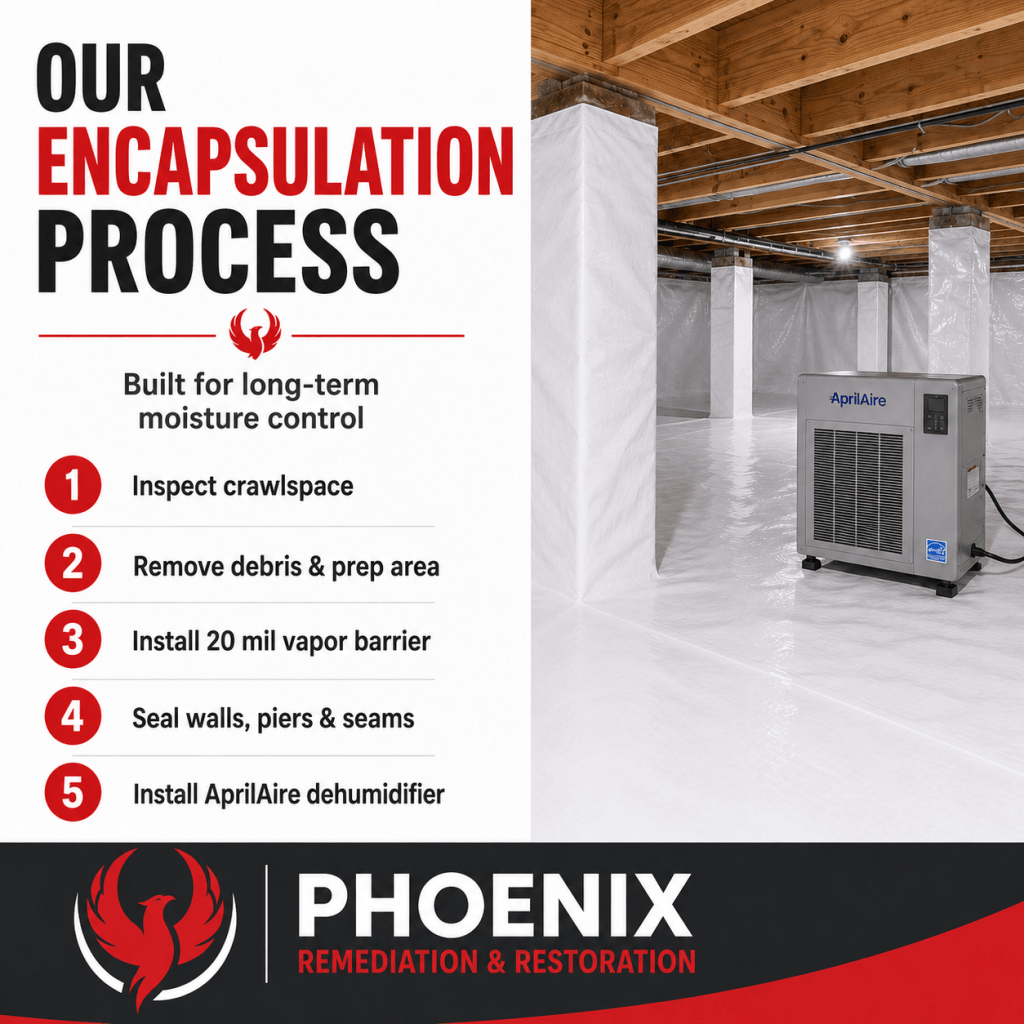
Why Crawlspace Dehumidification Matters
After reducing ground moisture and outside-air infiltration, humidity still needs to be managed.
A properly sized crawlspace dehumidifier can help maintain controlled relative-humidity conditions.
This is especially important during humid Kentucky summers.
The purpose of encapsulation and dehumidification is to help put moisture control back into the hands of the property owner instead of allowing outdoor weather conditions to determine what happens beneath the home.
A crawlspace dehumidifier may also be installed so that it remains elevated from the floor and protected from incidental water conditions.
To keep up with Phoenix restoration and moisture-control information, you can follow our presence on Alignable.
Crawlspace Condensation Can Be Misleading
Water underneath a home does not always mean that groundwater is entering through the foundation.
Sometimes the problem is condensation.
During hot and humid weather, warm moisture-laden air can enter the crawlspace and contact cooler surfaces such as:
- HVAC ductwork
- Supply trunks
- Plumbing
- Metal components
- Cooler structural surfaces
When those surfaces are below the dew point of the surrounding air, condensation can form.
That water may drip onto the vapor barrier or framing and appear to be a leak.
This is another reason a proper crawlspace assessment should consider:
- Temperature
- Relative humidity
- Dew point
- Moisture content
- Surface conditions
- HVAC operation
- Drainage
Correct diagnosis matters.
Can a Wet Crawlspace Cause Mold?
Yes.
Persistent elevated moisture can create conditions favorable for mold growth.
Organic building materials in crawlspaces can include:
- Floor joists
- Subflooring
- Beams
- Rim joists
- Wood columns
- Insulation paper
- Stored materials
When these materials remain damp, microbial growth may develop.
Common warning signs include:
- Musty odors
- Visible discoloration
- Fungal-like growth
- Elevated wood moisture
- Condensation
- Persistent high humidity
- Damp insulation
Phoenix provides mold-related inspection and remediation services in addition to crawlspace moisture-control work.
You can learn more about our restoration background through our EZlocal company listing.
Should Mold Be Remediated Before Encapsulation?
If microbial growth is present, it should generally be evaluated and properly addressed rather than simply covered with a new liner.
A crawlspace project may require a sequence such as:
- Identify the source of moisture.
- Correct active water intrusion.
- Remove standing water when necessary.
- Remove contaminated or unsalvageable materials where appropriate.
- Establish containment when needed.
- HEPA vacuum affected surfaces.
- Clean or treat applicable structural materials.
- HEPA vacuum again as appropriate.
- Dry structural materials.
- Correct drainage problems.
- Install the encapsulation system.
- Install or configure dehumidification.
- Monitor moisture conditions.
The exact scope depends on what is discovered during the inspection.
Why Encapsulating Over a Wet Crawlspace Is a Bad Idea
Installing a beautiful new liner does not solve the problem if saturated soil, wet framing or standing water remain underneath it.
Before final encapsulation, the crawlspace may need to be properly dried.
This can involve:
- Water extraction
- Removal of wet materials
- Air movement
- Dehumidification
- Moisture monitoring
- Drainage improvements
Encapsulating before the crawlspace is ready can trap problems instead of solving them.
That is one of the reasons Phoenix Remediation & Restoration combines restoration experience with crawlspace moisture-control services.
What Are the Benefits of Crawlspace Encapsulation?
A properly designed and installed crawlspace encapsulation system can provide several benefits.
Reduced Ground Moisture
A sealed liner helps reduce water vapor entering from exposed soil.
Better Humidity Control
Reducing outside-air and ground-moisture influence makes the crawlspace easier to condition.
Reduced Mold Risk
Lower moisture levels can make conditions less favorable for microbial growth.
Cleaner Crawlspace
A durable liner provides a cleaner surface for future inspection and service work.
Protection of Structural Materials
Controlling moisture can help protect wooden framing components from prolonged damp conditions.
Reduced Musty Odors
Moist crawlspaces can contribute to persistent odors. Controlling moisture and addressing existing contamination can help reduce the source of those odors.
Better Long-Term Monitoring
A clean encapsulated crawlspace can make new leaks or drainage problems easier to identify.
Does Crawlspace Air Affect the Rest of the House?
The crawlspace and living space are not completely isolated from one another.
Air can move through penetrations, wall cavities, plumbing openings, framing gaps and other pathways.
For this reason, crawlspace humidity and odors can potentially influence conditions inside the home.
Controlling crawlspace moisture is therefore about more than improving an area homeowners rarely see.
It can be part of managing the overall building environment.
What Should Be Inspected Before Crawlspace Encapsulation?
A thorough crawlspace evaluation should consider more than the vapor barrier.
We look for conditions involving:
Drainage
Is water entering the crawlspace?
Grading
Does exterior water flow toward or away from the foundation?
Gutters and Downspouts
Where does roof runoff discharge?
Structural Framing
Are joists, beams or subflooring displaying signs of moisture damage?
Existing Vapor Barrier
Is it complete, damaged, thin or improperly installed?
Plumbing
Are there active or historical leaks?
HVAC
Is condensation occurring on ductwork?
Foundation Conditions
Are there cracks, openings or other visible concerns?
Mold or Microbial Growth
Is suspicious growth present on structural components?
Moisture Content
Are wood materials currently wet?
Relative Humidity
Are environmental conditions conducive to continued moisture problems?
A complete inspection helps determine what should happen before, during and after encapsulation.
Crawlspace Encapsulation Is a System, Not Just Plastic
This is one of the most important things homeowners should understand.
A quality crawlspace encapsulation project may involve:
Drainage + Water Control + Vapor Barrier + Air Sealing + Dehumidification + Moisture Monitoring
Simply laying plastic on the ground addresses only one part of the equation.
When comparing crawlspace contractors, ask exactly what is included in their system.
You can also review Phoenix across multiple platforms, including our Google profile, LinkedIn profile, YouTube channel and Restoration Directory listing.
Crawlspace Encapsulation in Mount Sterling and Central Kentucky
Phoenix Remediation & Restoration provides crawlspace moisture-control and restoration services throughout Central and Eastern Kentucky.
Our service area includes communities surrounding:
- Mount Sterling
- Lexington
- Winchester
- Morehead
- Richmond
- Stanton
- Owingsville
- Campton
- And surrounding Kentucky communities
Property conditions differ significantly from one location to another, so recommendations are based on what we find at the property rather than using a one-size-fits-all package.
Why Choose Phoenix Remediation & Restoration?
We approach crawlspaces from a restoration and moisture-management perspective.
That is an important distinction.
Instead of asking only:
“How much liner does this crawlspace need?”
We want to know:
Why is this crawlspace wet?
Where is the moisture coming from?
Is drainage contributing to the problem?
Is mold already present?
Are the structural materials dry enough to encapsulate?
How will humidity be controlled after installation?
What will prevent the same conditions from returning?
That diagnostic approach allows us to develop a more complete moisture-control strategy.
Visit Phoenix Remediation & Restoration online to learn more about our company and property-restoration services.
Frequently Asked Questions About Crawlspace Encapsulation
How much does crawlspace encapsulation cost?
Pricing depends on several factors, including:
- Crawlspace square footage
- Height and accessibility
- Vapor barrier thickness
- Number of walls
- Number of piers or columns
- Existing insulation
- Existing vapor barrier removal
- Drainage requirements
- Sump pump requirements
- Dehumidifier requirements
- Mold remediation
- Structural repairs
- Amount of preparation required
An inspection is the most reliable way to establish an appropriate scope.
Schedule your crawlspace inspection with Phoenix here.
Is crawlspace encapsulation worth it?
When a crawlspace has persistent moisture or humidity problems, properly designed encapsulation can be an effective component of a larger moisture-control strategy.
The important part is correcting water and drainage problems first.
Do I need a dehumidifier after encapsulation?
Many encapsulated crawlspaces benefit from mechanical dehumidification.
The decision should depend on the crawlspace design, environmental conditions and moisture load.
Can you encapsulate over an old vapor barrier?
The existing material should first be evaluated.
Damaged, contaminated or poorly installed liners may need to be removed so the underlying soil and conditions can be properly assessed.
Can encapsulation fix standing water?
Encapsulation itself is not designed to correct significant standing-water conditions.
Drainage, groundwater or exterior water-management problems should be addressed before final encapsulation.
Can crawlspace encapsulation prevent mold?
Encapsulation can help reduce moisture conditions that contribute to mold growth, but it does not guarantee that mold can never occur.
Existing mold should also be evaluated before the crawlspace is sealed.
Take Control of the Environment Under Your Home
A crawlspace should not be ignored until damaged floors, mold, odors or structural problems become visible upstairs.
If your crawlspace has:
- Standing water
- High humidity
- Mold growth
- Condensation
- Wet insulation
- Sagging vapor barrier
- Exposed soil
- Musty odors
- Drainage problems
it is worth having the conditions professionally evaluated.
At Phoenix Remediation & Restoration, our goal is to determine what is causing the moisture and create a plan designed around the property.
Phoenix Remediation & Restoration
Crawlspace Encapsulation • Drainage Solutions • Mold Remediation • Water Damage Restoration • Waterproofing
Call or Text: 859-585-3750
Schedule Your Crawlspace Inspection
Visit Phoenix Remediation & Restoration
Connect With Phoenix on LinkedIn
View Phoenix on The Restoration Directory